Costume
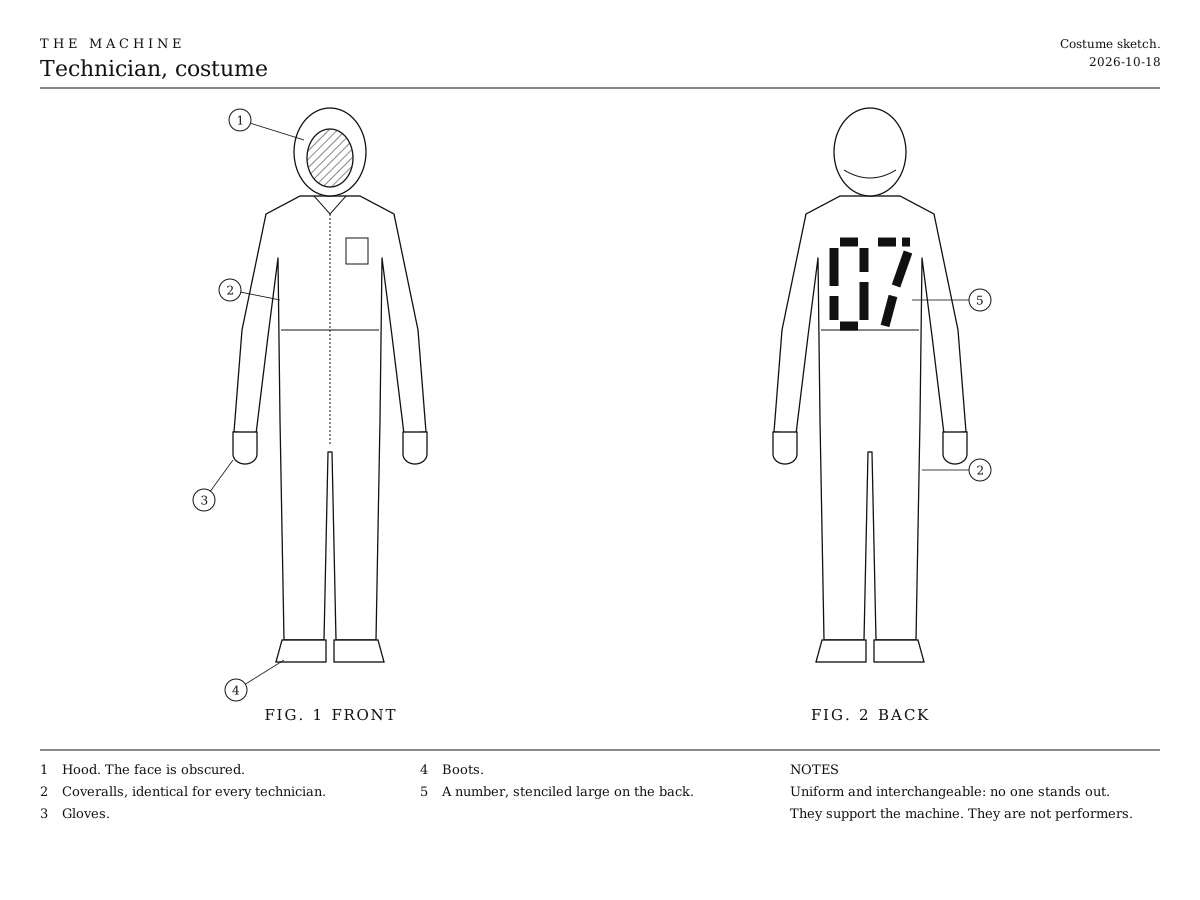
- Coveralls, identical for every technician.
- A number stenciled on the back of each.
- Appearance obscured, so technicians look roughly uniform, interchangeable and uninteresting. Their presence shouldn't distract from the elements.
On stage
- Technicians bring units on and take them off. The building is part of the work, and it stays visible.
- Bring a unit out, turn it on, and walk away. Never reset, rewind or re-cock an instrument by hand: every unit resets itself.
- Hit a unit's stop switch before lifting it. It is a safety step and part of the choreography.
- To open Metronome to metronome, a technician starts the Metronome swinging by hand. The system takes it over from there.
- A unit with a fault shows it on its own light. Read it when you come to carry the unit off.
Technicians and performers
A performer is meant to influence the audience's emotional experience. A technician is not. Technicians support the elements, and it is the elements that are meant to stir thoughts and feelings in the people watching.
A presentation may have both, and one person can fill both roles in it: they wear technician gear while serving as a technician, then change into performance attire to perform.
Performance attire
Clothing markedly different from what a performer might commonly wear in their culture. In the Western classical tradition this has meant a lot of black and white formal wear, which is a fine option but not necessary.
The goal is to dress in a way that reminds the performer and the audience that this shared moment is special, set apart from the mundane procession of daily life.