How it works
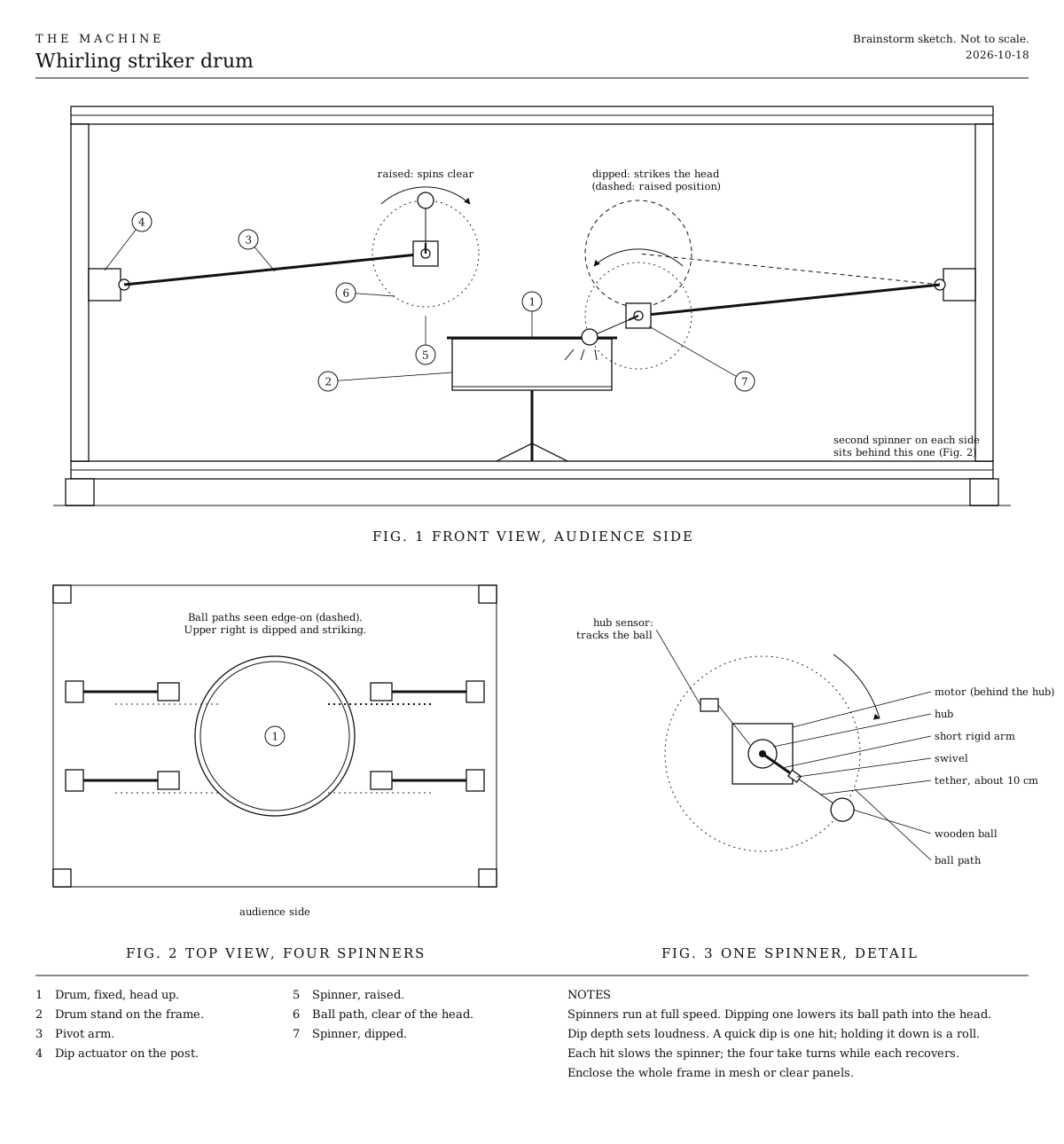
- Spinners are motors whirling a wooden ball on a short tether. They run at full speed all the time and strike only when moved so the ball’s path crosses the drum head.
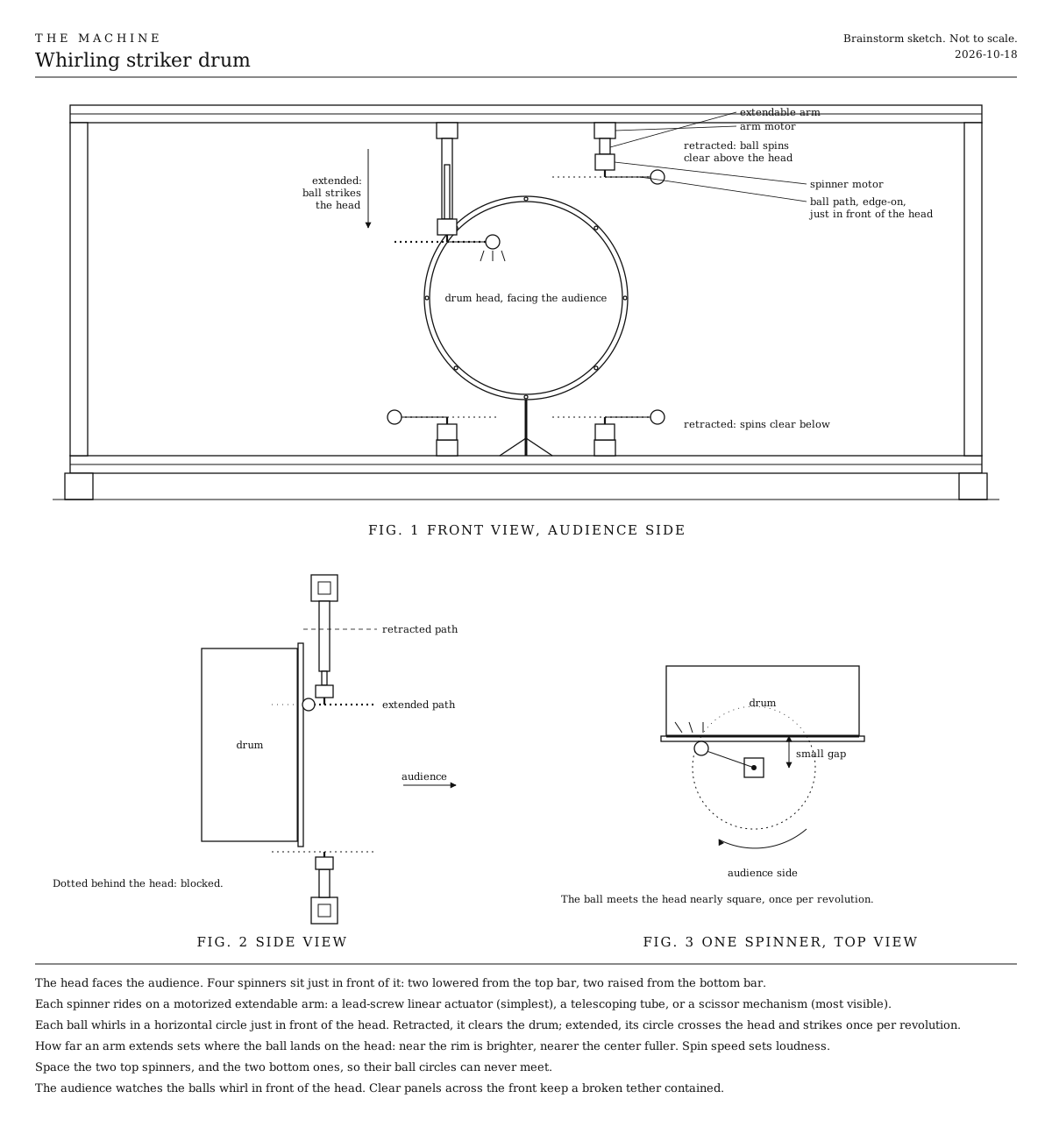
- Main version: one drum fixed in the center of an extrusion rectangle, head facing the audience. Four spinners sit just in front of the head: two lowered from the top bar and two raised from the bottom bar, each on a motorized extendable arm.
- Each ball whirls in a horizontal circle just in front of the head. Retracted, the circle clears the drum; extended, it crosses the head and strikes once per revolution.
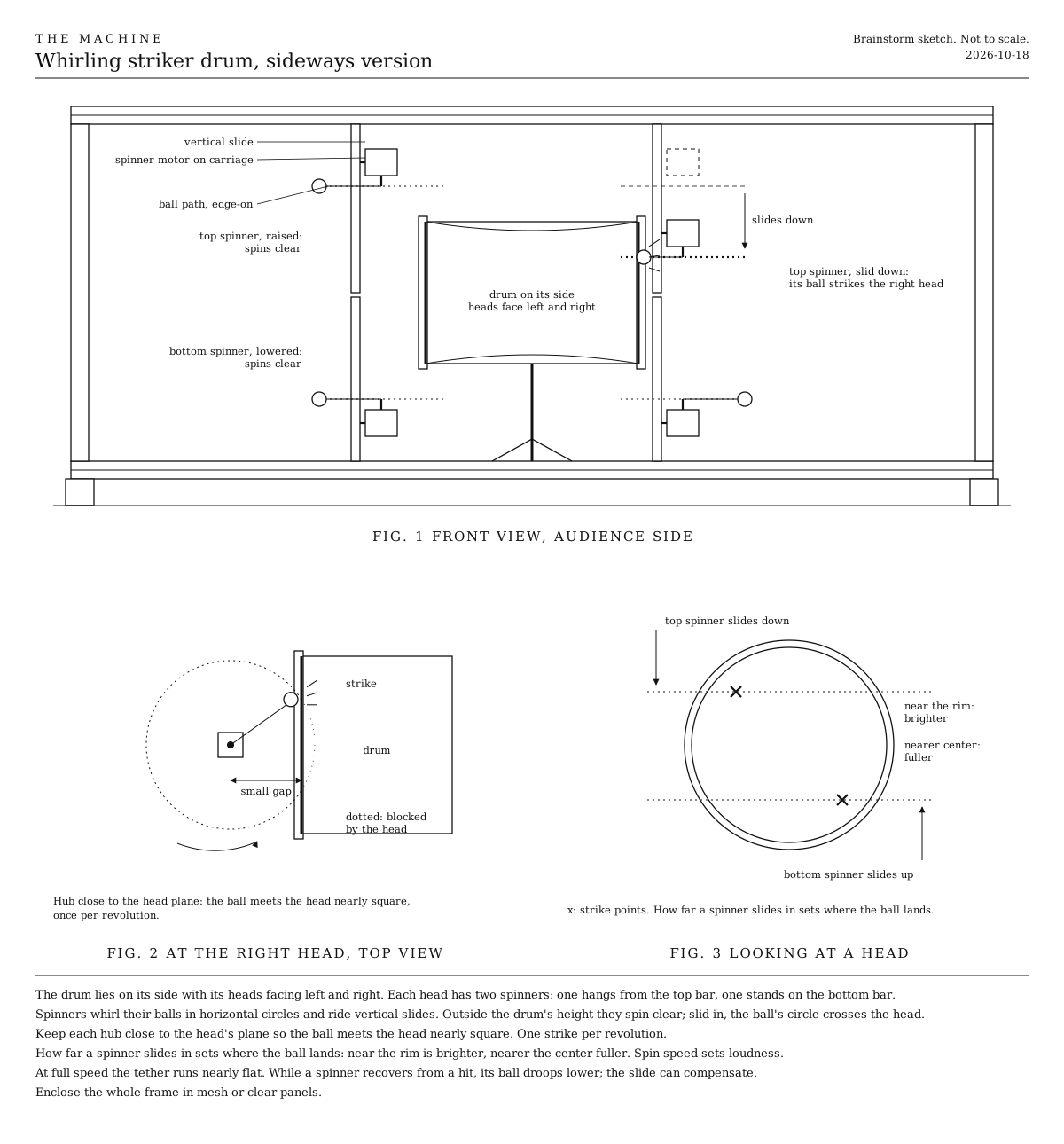
- Keep each hub close to the head’s plane so the ball meets the head nearly square.
- How far an arm extends sets where the ball lands: near the rim is brighter, nearer the center fuller. Spin speed sets loudness.
- Space the two top spinners, and the two bottom ones, so their ball circles can never meet.
- At full speed the tether runs nearly flat. While a spinner recovers speed after a hit, its ball droops lower; the arm can compensate.
- Each hit slows only the light ball; it is pulled back up to speed within a revolution or two. The four take turns.
Extendable arms
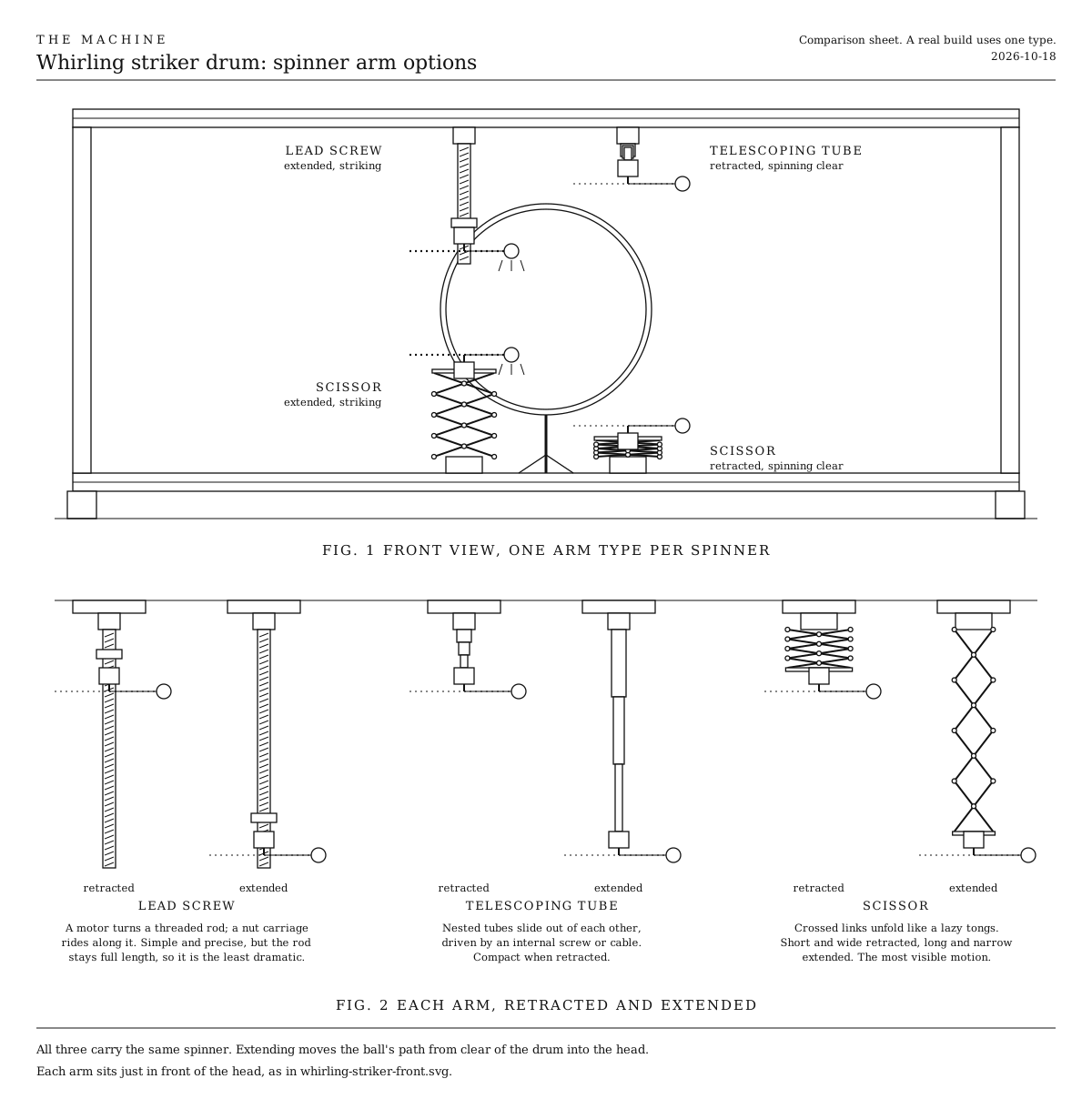
- Options: lead-screw linear actuator (simplest), telescoping tube, or scissor mechanism (most visible). A build uses one type.
- Only lead-screw slides are truly off the shelf (CNC and 3D printer parts that mount to extrusion). A scissor arm is a build, not a purchase; drive it fast near its folded end (crank or cam) rather than with a slow screw, since off-the-shelf scissor lifts are geared for force and are slow. A belt-driven slide is the fast alternative to a screw.
Timing
A single hit means moving in after the ball passes and out before it returns, within one revolution. Make that window workable:
- Spin slower with a longer tether: about 30 cm at 120 rpm keeps the tether within roughly 12 degrees of flat, hits at about 3.8 m/s, and gives half a second per revolution.
- Park each spinner just clear of the head with the slow positioning move, so the strike move is only 1 to 2 cm (about 80 mm/s, within a plain lead screw’s reach).
- A sensor on each hub tracks the ball; the move in starts just after the ball passes the strike point. Staying in for n revolutions gives n hits.
- Set rpm to the tempo (120 rpm = 120 BPM, one revolution per beat) so every hit lands on the grid. Spinners at different multiples play different subdivisions. Briefly changing a spinner’s rpm shifts its hits off the grid.
Tether
- Use stiff trimmer line rather than soft string, like a string trimmer, so it straightens itself after each hit. A felt- or leather-covered ball reduces wear on the head.
Risks
- Tangling is the main risk: the ball rebounds, the tether goes slack, and it can wrap the hub. Tie the tether to the end of a short rigid arm on the hub, use a fishing swivel, and switch to a short chain or a hinged rigid link (flail) if tethers keep fouling.
- Clear panels across the front keep a broken tether contained while the audience watches the balls whirl.
First test
- One spinner on a cordless drill, 30 cm of trimmer line with a wooden bead, held so the path just reaches a drum head, filmed in slow motion. It shows whether the tether recovers cleanly and how it sounds.