How it works
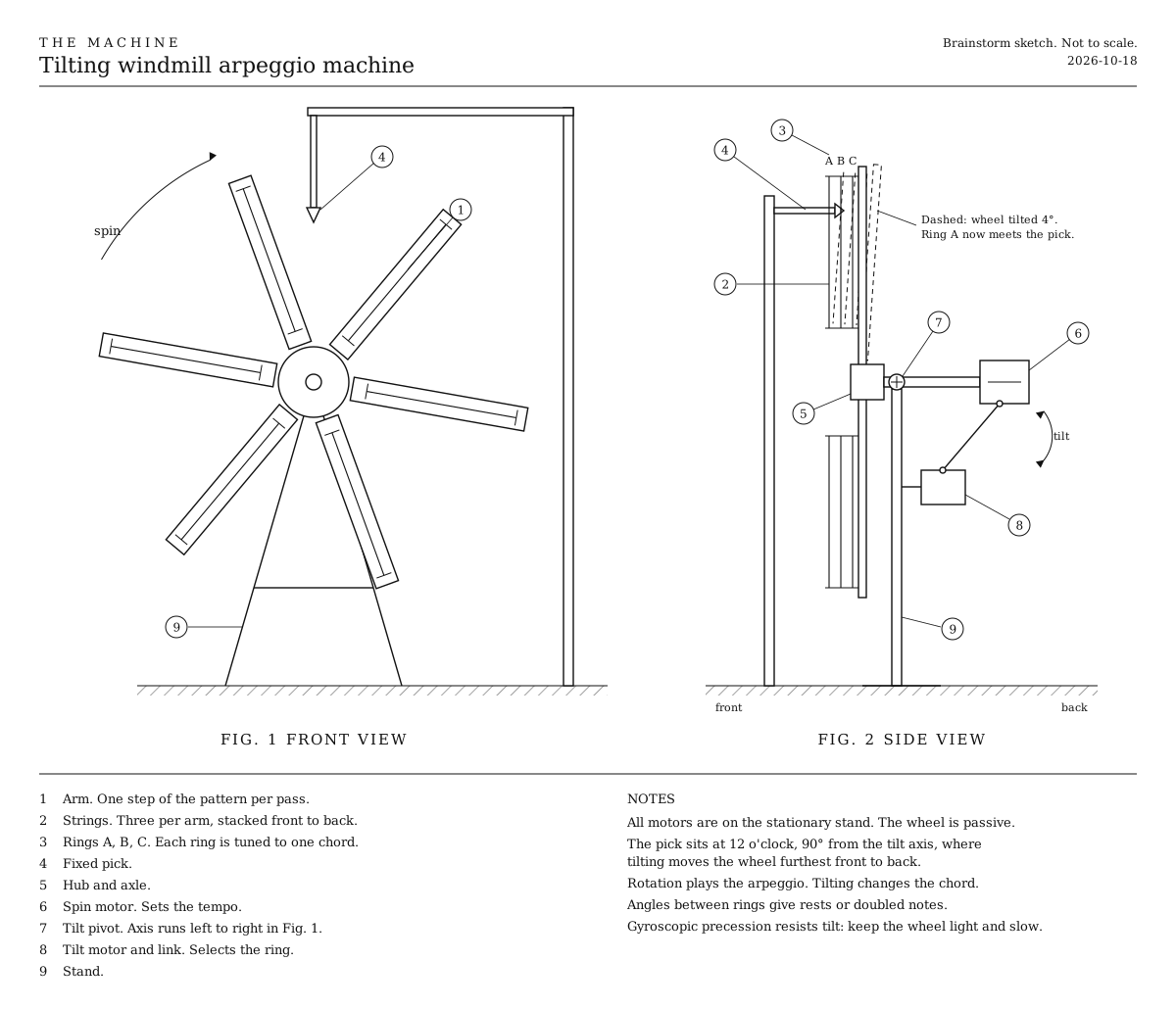
- A wheel of single-string arms rotating past a fixed pick. Each arm is a step in a physical step sequencer; rotation speed is the tempo.
- Each arm: small resonator box plus piezo (or room mics, which suit the passive tilting version).
- For powered arms, all electronics ride on the wheel (hub controller, battery). Only wireless control crosses the rotating boundary.
Selecting notes
Three ways to choose notes, which can be combined:
- Hinged arms (rhythm). A folded arm misses the pick and is a rest. Arms must latch in both positions.
- Motorized tension per arm (pitch). Range is roughly a fourth to a fifth per string, which suits voice leading between chords. Retune on the back half of the rotation; retuning while a string rings gives a glide.
- Tilting axis (chord). Each arm carries several strings stacked front to back, forming rings; each ring is tuned to a chord. A motor tilts the wheel’s axis so a different ring passes through the fixed pick. In-between angles can give rests or doubled notes.
- All motors sit on the stationary stand, so the wheel itself is passive (no electronics on it).
- Gyroscopic precession pushes back on the tilt, so keep the wheel light and slow and size the tilt motor for it.
- Place the pick 90 degrees from the tilt axis, where tilt gives the most travel.
- Sliding the axle or moving the pick selects rings the same way with no gyroscopic fight, but is less dramatic to watch.
Build order
- 1 arm with counterweight, then 2, 4, then 8 or 16. Fixed-pitch arms first, tuning later.
Variations
- The wheel can turn on a horizontal axis, like a windmill, or lie flat, like a carousel.
- In the tilting version, the strings can ride on the wheel past a fixed pick, or the wheel itself can be the pick, reaching fixed strings around it.
References
- Leslie speaker. Rotating sound source; the windmill instruments move sound around the room in a similar way.