Why a catapult
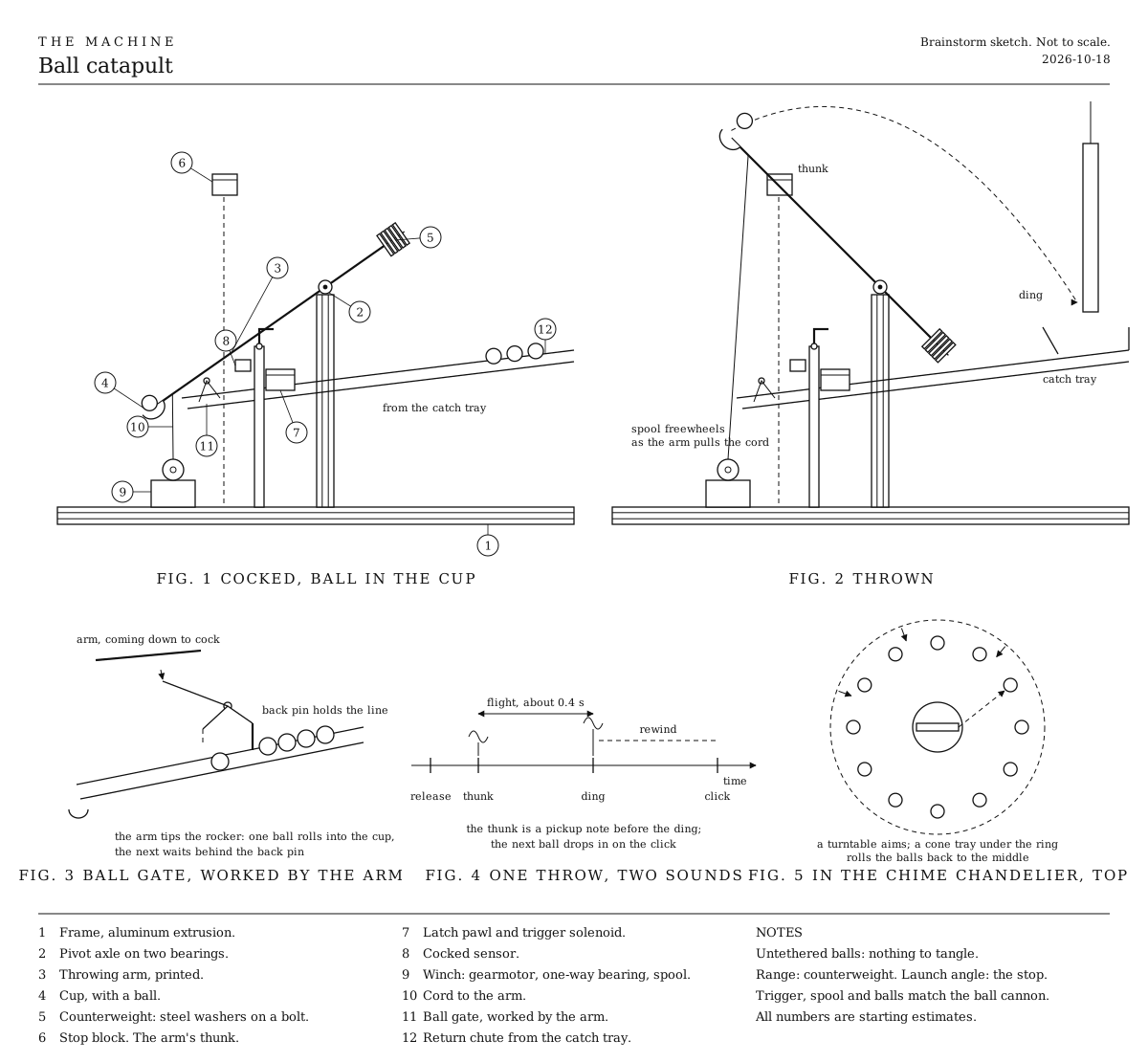
The ball cannon fires level and fast on a tether. A catapult does the same job a different way, and some of the differences are the point.
- It lobs. The ball travels in a slow, high arc the audience can follow, instead of a fast level shot.
- Nothing is tied to the ball. No tether to tangle, no reel to fault. Several balls circulate, so the note rate is set by how fast the arm re-cocks, not by reeling one ball home.
- One throw makes two sounds. The arm hits its stop block with a thunk, and a moment later the ball strikes. The flight time sits between them like a pickup note.
- The mechanism is the show. A weight drops, an arm swings, a winch hauls it back down, a ball rolls into the cup. Every step is visible and roundabout.
What it gives up: aim is looser than the cannon’s, balls need a catch tray and a path home, and it is bigger and louder.
How it works
- Cocked. The winch has pulled the long end of the arm down, raising the counterweight on the short end. The latch pawl holds the arm. The cup sits at the bottom of the return chute.
- Load. Coming down, the arm tipped the ball gate: one ball rolled into the cup, and the next waits behind the gate’s back pin. No extra motor.
- Fire. The solenoid lifts the pawl. The counterweight drops and the arm swings up.
- Stop. The arm hits the stop block and halts. The ball keeps going. The stop’s angle sets the launch angle; the counterweight sets the speed.
- Flight. The ball lobs to the target. The winch’s spool freewheels on its one-way bearing as the arm pulls the cord out.
- Strike. The ball hits the target and drops into the catch tray, which feeds the return chute.
- Rewind. The winch pulls the arm back down until the pawl clicks and the cocked sensor confirms. Loading happens on the way down, so it is ready to fire again.
The trigger, the cocked sensor, the one-way spool and the balls are the same parts as the ball cannon, so one set of spares serves both.
The stop block
- The stop takes the arm’s full swing on every throw, so it has to be solid, but it doesn’t have to be quiet. A wood block, a cowbell or a small drum turns it into an instrument.
- Move the stop to change the launch angle. Pad it to soften the thunk.
- The arm must not bounce off the stop and swing back through the next ball’s path. A latch or a damper at the top of the swing may be needed.
Getting the balls home
- A catch tray under the target funnels balls into a chute that runs back to the cup, all downhill. The target sits higher than the cup.
- The ball gate passes exactly one ball per cock.
- A few balls will bounce out over a long performance. Start with a handful in the chute, and fence the target with a lip or netting.
- An empty cup still makes the thunk with no strike after it. That may be useful.
Where it could be used
- In place of the cannon in the chime chandelier. The catapult sits on a turntable in the middle of the ring of tubes, lobbing at them. A cone-shaped tray under the ring rolls balls back to the middle.
- At targets laid flat. A drum head facing up, a bell mouth up, tuned bars. A lob lands on top of things where the cannon hits from the side.
- Next to the cannon. Both aimed at the same chimes: fast level shots and slow lobs, with different delays to the strike.
Starting estimates
Rough numbers to size a first prototype, all to be checked on the bench.
| Quantity | Estimate | Basis |
|---|---|---|
| Ball | 25 mm wooden, about 5 g | Same as the ball cannon |
| Range | 0.6 to 1.0 m | A lob across a small stage set |
| Launch angle | 45° | Set by the stop |
| Launch speed for 0.8 m | About 2.8 m/s | √(g × range), landing level |
| Flight time | About 0.4 s | 2 × speed × sin 45° ÷ g |
| Peak height above release | About 0.2 m | speed² × sin² 45° ÷ 2g |
| Arm | 220 mm long side, 75 mm short side | About 3 to 1 |
| Arm swing | About 80° | 35° below level when cocked to 45° above at the stop |
| Counterweight drop | About 0.1 m | Short side through the swing |
| Energy needed | About 0.1 J | 0.02 J in the ball, assuming about a fifth of the counterweight’s energy reaches it; a lighter arm wastes less |
| Counterweight | About 100 to 150 g of washers | 0.1 J over a 0.1 m drop |
| Winch pull | Under 1 N at the arm | Holding the counterweight at the end of the short side |
| Rewind | About 4 spool turns | Roughly 250 mm of cord on a 10 mm spool |
What these suggest:
- The reset is gentle. The cannon’s N20 gearmotor has plenty of margin.
- The arm’s own weight matters more than the ball’s. A light, stiff arm throws farther for the same counterweight.
- The 0.4 s flight is a fixed delay, like the cannon’s. Fire that much early to land the strike on the beat; the thunk then lands 0.4 s ahead of it.
- Note rate is set by the rewind, probably one throw every few seconds. Two catapults taking turns would double it.
Sensing and faults
- Cocked sensor on the pawl: the only proof it is safe and ready.
- Winch current: a rise means the arm has reached the latch, or something is jammed.
- No latch. The winch runs past a time limit without the sensor reading engaged. Stop and hold.
- Stall. Current rises early. Stop, back off, try once slowly, then hold.
As with the cannon, a fault shows as an LED pattern on the unit, since units only listen and can’t report over the radio. It never fires from a fault.
Build and test plan
- Arm, axle and stop by hand. Cock it with a finger, release it, throw a ball. Find the counterweight and stop angle that reach 0.8 m.
- Latch and solenoid. Reuse the cannon’s trigger. Check the latch holds under the counterweight and releases cleanly.
- Winch. Add the one-way spool and gearmotor. Check the cord doesn’t slow the throw.
- Ball gate and chute. Check one ball, every time, at the bottom of every cock.
- Catch tray. Throw a few hundred balls at a target and count how many come home.
- Timing. Measure release to thunk and release to strike, and how much each varies.
Variations
- A counterweight that hangs from a hinge, as on a trebuchet, puts more of its energy into the ball, but swings around on its own.
- A sling, as on a trebuchet, throws farther and looks more dramatic, but its release is harder to make consistent.
References
- Mangonel and trebuchet. Throwing engines with a swinging arm. The mangonel stops its arm on a crossbar; the trebuchet uses a falling counterweight.
- Wintergatan Marble Machine. A hand-cranked machine that plays music by dropping marbles onto instruments, with the marbles running home on tracks. Gravity does the playing.