Built around one ball cannon, which fires a tethered wooden ball at a tube, reels it back and re-cocks itself. The tubes hang around it like a chandelier.
Two layouts
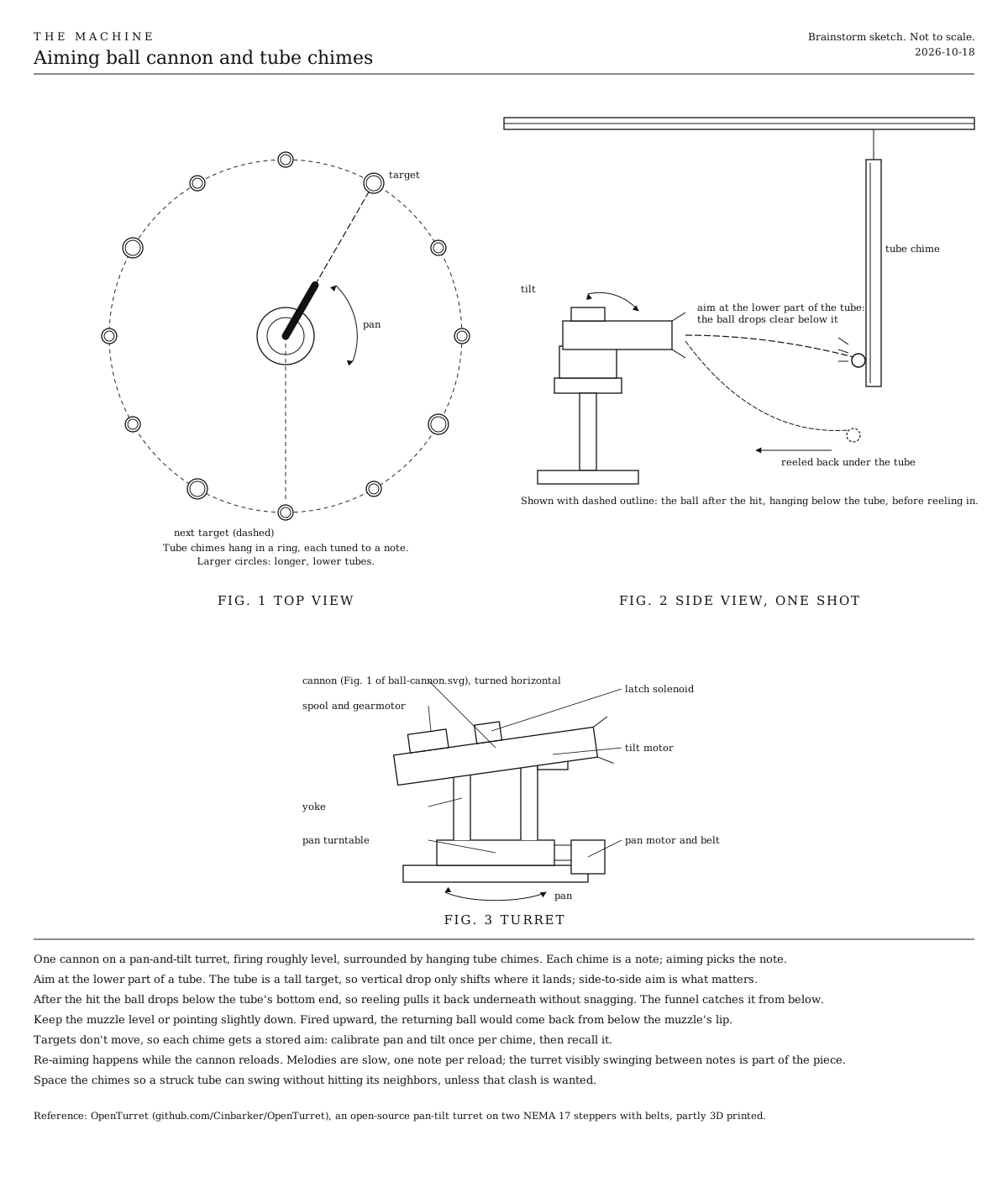
- Turret. The cannon sits on a pan-and-tilt turret, firing roughly level, surrounded by a ring of hanging tube chimes. Two steppers with belts turn it, as in the open-source OpenTurret design.
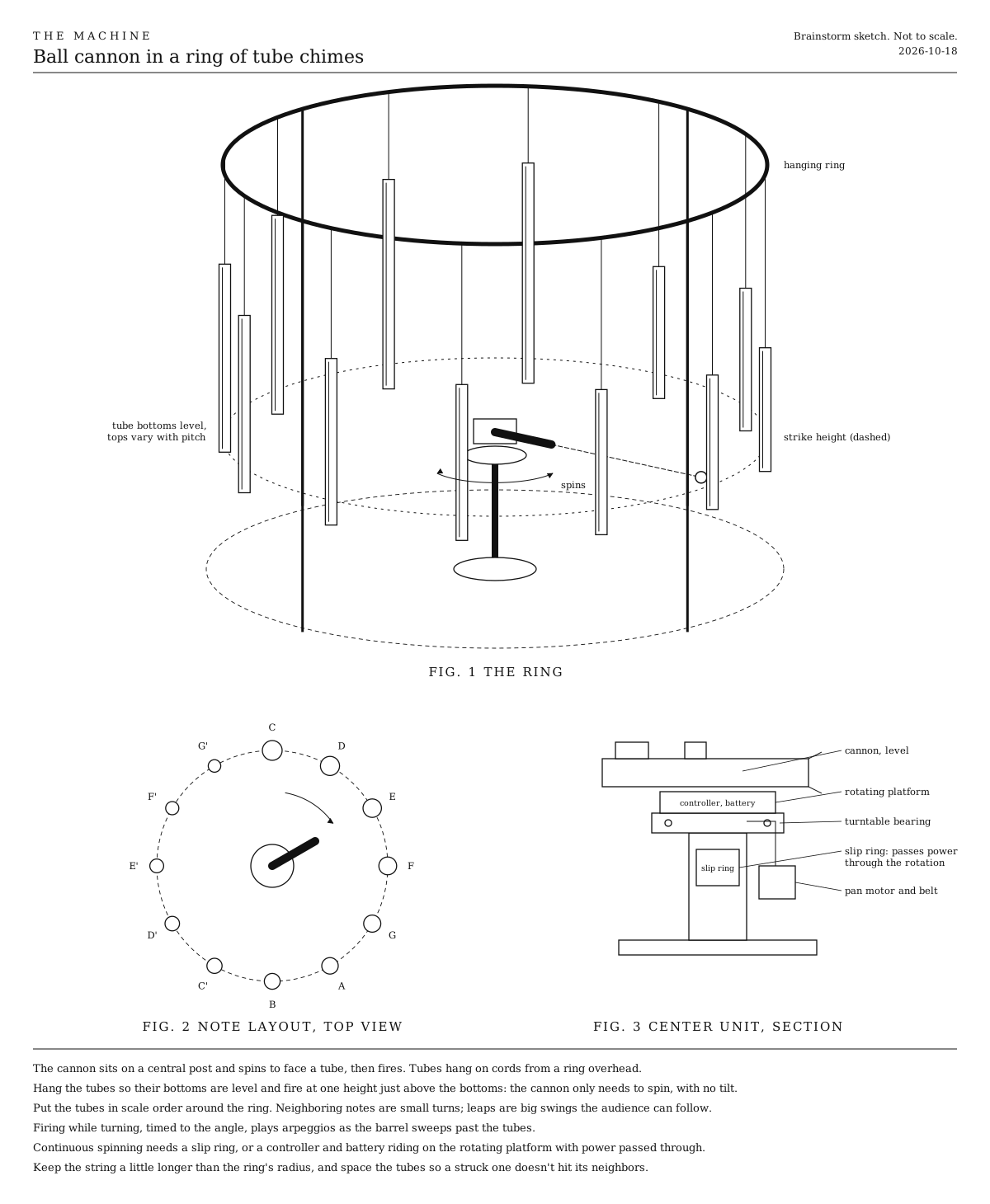
- Ring. The cannon sits on a central post inside a ring of tube chimes hung on cords from an overhead ring. Hang the tubes so their bottoms are level and fire at one height just above them; then the cannon only spins, with no tilt axis. Continuous spinning needs a slip ring, or a controller and battery riding on the rotating platform.
Aiming at the chimes
- Each chime is a note, so aiming picks the note.
- Aim at the lower part of a tube. The tube is a tall target, so the ball’s drop over the shot only shifts where it lands; side-to-side aim is what matters.
- After the hit the ball drops below the tube’s bottom end, so reeling pulls it back underneath without snagging, and the funnel at the muzzle catches it from below.
- Targets don’t move, so each chime gets a stored aim: calibrate pan and tilt once per chime, then recall it.
- The turret re-aims while the cannon reloads. Melodies are slow, one note per reload, and the turret visibly swinging between notes is part of the piece.
- In the ring layout, put the tubes in scale order: neighboring notes are small turns, leaps are big swings the audience can follow. Firing while turning, timed to the angle, plays arpeggios as the barrel sweeps past.
- Space the chimes so a struck tube can swing without hitting its neighbors, unless that clash is wanted.
- Keep the string just long enough to reach the farthest chime: less slack to tangle, and it doubles as a safety leash.
References
- OpenTurret. Open-source pan-tilt turret on two NEMA 17 steppers with belts and TMC2209 drivers, partly 3D printed; build documentation not yet published. Model for the ball cannon’s turret.
- Slip rings. Rotary electrical joints for passing power onto a spinning part.